

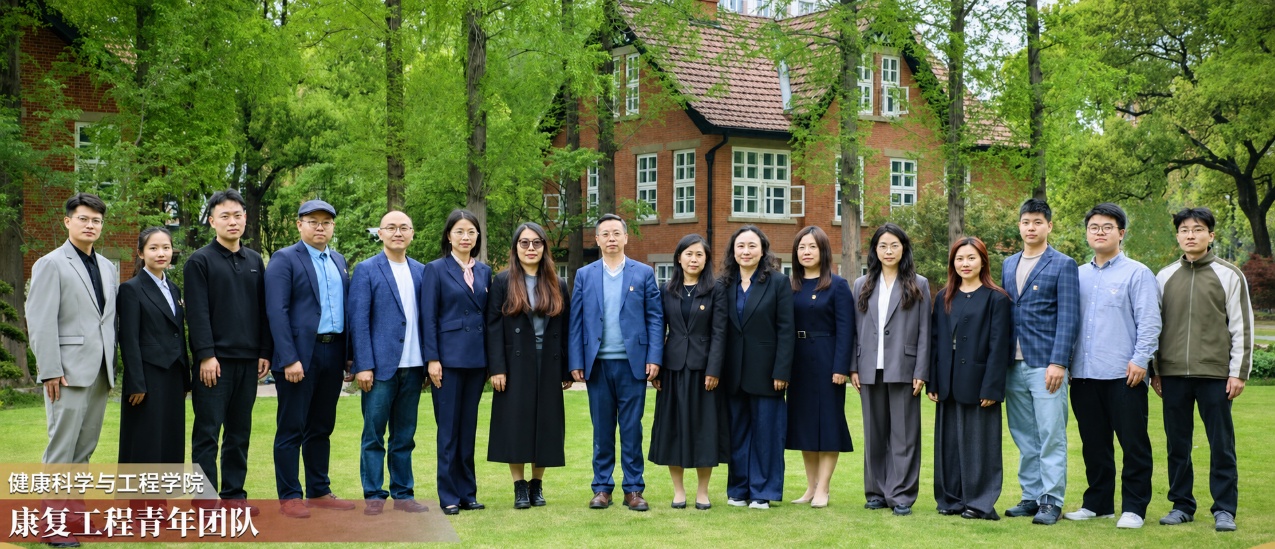
团队负责人
团队成员
喻洪流、李素姣、孟巧玲、杜妍辰、张宇玲、王明辉、尹梓名、宋晓燕、唐鸿雁、陆耀东、汪晓铭、罗胜利、李慧、王琰晶、王述弘
团队简介
团队由喻洪流教授领衔,长期致力于智能康复装备领域的研究,主要研究方向包括:(1)智能康复机器人;(2)智能护理机器人;(3)智能仿生假肢与外骨骼机器人;(4)智能康复评估与治疗决策;(5)生命参数监测;(6)人体生物力学与运动控制;(7)神经功能调控。
智能康复工程团队现有成员近150人,其中包括近20名教师。
代表性成果
1.科研项目
[1]2022-2025年,国家重点研发计划项目,失能老人智能照护机器人系统关键技术及产品研发
[2]2023-2026年,国家重点研发计划-课题,卧床老人刚柔耦合肢体康复训练机器人技术
[3]2022-2025年,国家重点研发计划-课题,智能离床照护机器人技术与产品研发
[4]2022-2025年,国家重点研发计划-课题,虚实融合的多感觉刺激上肢康复机器人系统研发
[5]2020-2023年,国家重点研发计划-课题,基于多源生物信息的运动模式智能识别
[6]2025-2028年,国家自然科学基金-面上项目,新型髋膝一体化智能仿生假肢关节驱动机理与协同控制研究
[7]2021-2024年,国家自然科学基金-面上项目,主被动混驱仿生膝关节假肢人机耦合动力学与协调控制研究
[8]2020-2022年,国家自然科学基金-面上项目,具有恒力特性的人工肛门括约肌生物力学机理及设计方法研究
[9]2015-2018年,国家自然科学基金-面上项目,步态跟随式仿生智能假腿的动力学与控制方法研究
[10]2025-2026年,上海市“先锋者计划”生物混合机器人专项,神经调控-肌肉驱动-机械协同:精细联动的生物混合灵巧手
[11]2023-2026年,上海市自然基金,基于智能软复合关节的柔性上肢外骨骼仿生驱动机理与控制方法
[12]2023-2026年,上海市扬帆计划,融合生理信号的踝关节康复机器人优化设计及协调控制研究
[13]2022-2023年,中国残疾人联合研究中心,家用型柔性链末端驱动手功能康复训练器研制
2.发明专利
[1]喻洪流等;一种康复机器人智能主被动混合训练控制方法,ZL202210863730.9
[2]喻洪流等;一种基于点云技术的助餐机器人智能取食系统,ZL202410082012.7
[3]喻洪流等;上肢康复机器人控制系统,ZL201810915150.3
[4]喻洪流等;识别人体肢体运动意图的传感器,ZL201810744009.1
[5]喻洪流等;一种具有实时调速功能的肌电假手控制方法,ZL201010196646.3
[6]喻洪流等;一种面向助浴任务的视觉辅助系统及存储介质,ZL202310843046.9
[7]喻洪流等;一种主被动混合驱动智能假肢膝关节的控制方法,ZL202211612998.1
[8]喻洪流,罗胜利等;一种磁动力髋离断假肢的助力机构,ZL202310431989.0
[9]孟巧玲等;一种用于轮椅的模块化越障辅助装置,ZL202310201317.0
[10]孟巧玲等;一种穿戴式柔性下肢助力外骨骼,ZL202111505445.1
[11]孟巧玲等;一种自平衡穿戴式柔性肘关节助力外骨骼,ZL202210041440.6
[12]孟巧玲等;一种穿戴式柔性下肢助力外骨骼控制系统,ZL202210037269.1
[13]孟巧玲等;一种自驱模块化半掌假手,ZL202210097806.1
[14]孟巧玲等;一种自适应抓握柔性假手,ZL202011506009.1
[15]孟巧玲等;一种基于有限状态机的柔性外骨骼手辅助抓握训练控制方法,ZL201911347021.X
[16]孟巧玲等;一种柔性康复外骨骼手套,ZL201911017522.1
[17]李素姣等;一种康复训练外骨骼机器人多运动模式控制系统及方法,ZL202510496092.5
[18]李素姣等;一种前臂无动力旋转的肘关节康复外骨骼,ZL202110043419.5
[19]李素姣等;一种医疗护理用多关节康复训练设备,ZL202310347176.3
[20]李素姣等;一种穿戴式肘关节外骨骼康复控制系统,ZL202110824366.0
[21]李素姣等;基于特征向量法的假肢接受腔设计量化补偿方法,ZL2021810226977.8
[22]李素姣等;一种辅具适配决策系统及方法,ZL202110441092.7
[23]杜妍辰等;一种中央驱动型三自由度人形机器人肩关节机构,ZL202511143478.4
[24]杜妍辰,喻洪流等;一种穿戴式多功能颈椎康复动力外骨骼控制系统,ZL202110742154.8
[25]王明辉等;一种绳传动式恒力夹持的人工肛门括约肌装置,ZL202111337202.1
[26]王明辉等;一种全开放式恒力接受腔,ZL202010480217.2
[27]唐鸿雁等;一种膝关节外骨骼机器人,ZL202310893934.1
[28]唐鸿雁等;一种双转子关节电机,ZL202510286052.8
[29]汪晓铭等;面向假肢髋膝耦合运动的膝关节能量管理系统,ZL202510388799.4
[30]汪晓铭等,一种髋膝协同仿生假肢,ZL202510388798.X
3.科技成果奖
[1]2025,国家教育部工程技术研究成果二等奖
[2]2023,中国康复医学会科学技术一等奖
[3]2020,上海市科学技术二等奖
[4]2019,国家教育部技术发明二等奖
[5]2019,中国康复医学会科学技术一等奖
4.学术论文
[1] Biomechanical Properties of the Large Intestine. Archives Of Computational Methods In Engineering, 2025, 32(2):645-661.
[2]Design and Swing Control of a Power-Assisted Hip Disarticulation Prosthesis. IEEE-ASME Transactions On Mechatronics, 2025, 31(1):290-300.
[3]Design and optimization of a novel sagittal-plane knee exoskeleton with remote-center-of-motion mechanism. Mechanism and Machine Theory, 2024, 194.
[4]A Gait Simulation and Evaluation System for Hip Disarticulation Prostheses. IEEE Transactions on Automation Science and Engineering, 2021, 18(2),448-457.
[5]Robot-Assisted Training to Improve Proprioception of Wrist. IEEE Transactions on Neural Systems and Rehabilitation Engineering : a Publication of the IEEE Engineering in Medicine and Biology Society, 2024, 32:570-576.
[6]Across Sessions and Subjects Domain Adaptation for Building Robust Myoelectric Interface. IEEE Transactions on Neural Systems and Rehabilitation Engineering, 2024, 32:2005-2015.
[7]A Wearable Computer Vision System With Gimbal Enables Position-, Speed-, and Phase- Independent Terrain Classification for Lower Limb Prostheses. IEEE Transactions on Neural Systems and Rehabilitation Engineering, 2023, 31:4539-4548.
[8]A Center of Mass Estimation and Control Strategy for Body-Weight-Support Treadmill Training. IEEE Transactions on Neural Systems and Rehabilitation Engineering, 2021, 29:2388-2398.
[9]Early Prediction of Lower Limb Prostheses Locomotion Mode Transition Based on Terrain Recognition. IEEE Sensors Journal, 2023, 23(22):27941-27948.
[10]Enhancing and Shaping Closed-Loop Co-Adaptive Myoelectric Interfaces With Scenario-Guided Adaptive Incremental Learning. IEEE Journal of Biomedical and Health Informatics, 2025, 29(11):8022-8033.
[11]Enhancing and Optimizing User-Machine Closed-Loop Co-Adaptation in Dynamic Myoelectric Interface. IEEE Transactions on Neural Systems and Rehabilitation Engineering, 2025, 33:1673-1684.
[12]Enhancing Locomotion-Mode Recognition and Transition Prediction with (Bio)Mechanical Sensor Fusion for Intelligent Prosthetic Knees. IEEE Journal of Biomedical and Health Informatics, 2025, 29(11):7955-7968.
[13]Six-degree-of-freedom upper limb rehabilitation robot based on tight-coupled dynamic interactive control: Design and implementation. Robotics and Autonomous Systems, 2025, 185.
[14]Abnormal gait partitioning and real-time recognition of gait phases in children with cerebral palsy.Biomedical Signal Processing and Control, 2023, 86.
[15]Bionic design to reduce driving power for a portable elbow exoskeleton based on gravity-balancing coupled model, Journal of Bionic Engineering, vol. 20, no. 1, pp. 146–157, 2023.
[16]Enhancing sEMG recognition with dynamic asymmetric training in context-informed virtual–real fusion system. Biomedical Signal Processing and Control, 2026, 113, 109235.
[17]柔性双手康复外骨骼抛接任务的过程协同控制. 机器人, 2021, 43 (06): 664-673.
[18]基于SMA驱动模块的腕部柔性外骨骼设计. 机器人, 2021, 43 (04): 406-413.
[19]基于空问末端引导式上肢康复机器人平面游戏的交互方式研究. 中国康复医学杂志, 2024, 39(7):1009-1014.
[20]基于STM32多维腰椎牵引装置控制系统设计与实现. 智能计算机与应用, 2022, 12(3): pp162-165.